

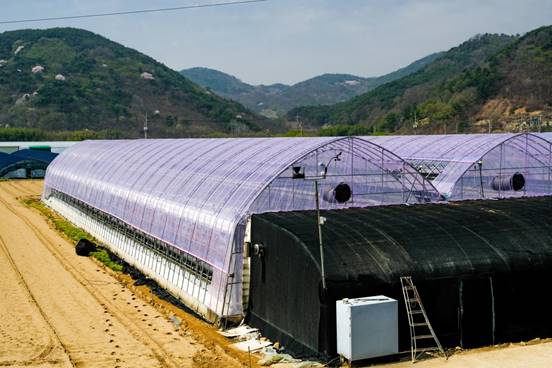
First, the type of greenhouse film
Greenhouse films are generally divided into four categories: PVC film, polyethylene PE film, vinyl acetate film, EVA film and polyolefin PO film.
1. Advantages of PVC film:
(1) After covering, the water droplets collected on the inner surface of the shed film can flow down the inclined surface to the corner of the shed, and the humidity in the shed is small, which can reduce the incidence of various diseases.
(2) There are no water droplets in the shed film, and the heat preservation is good, which is conducive to the safe wintering and rapid growth of the shed vegetables.
(3) Aging resistance, generally available for more than 2 years.
(4) The price is cheap
Shortcoming:
(1) The film width is generally 3-4m, and it needs to be bonded when used, which is not very convenient.
(2) After a long period of use, the outer surface of the shed is easy to stain with ash, which affects the light.
(3) Not environmentally friendly, polyethylene exposure to long-term exposure will release harmful gases. So it has been phased out by the market.
Because PVC PVC film has outstanding thermal insulation and cheap price, there is still a certain market.
2. Polyethylene PE film
Polyethylene PE film is divided into PE longevity non-drip film and PE longevity film, PE longevity non-drip film is also called PE longevity drip film, with a certain drip function, generally 3-4 months drip validity period. PE longevity film, also called PE aging resistant film, has no drip function.
Merit:
(1) The price is cheap
(2) Environmental protection and non-toxic
Shortcoming:
If PE longevity film is used, after covering, a large number of water droplets will accumulate on the inner surface of the shed film, which is easy to make the humidity too large and the disease increase. The presence of water droplets in the membrane will also seriously affect the light transmittance, resulting in low temperature and weak light in the shed, thereby hindering the growth of vegetables and reducing yield and efficiency. Even if PE longevity drip film is used, because the drip period is only 3-4 months, the validity period is short, and generally only one crop can be grown.
Polyethylene PE film is generally used more in the south.
3. Vinyl acetate EVA film
Advantages: good heat preservation is its outstanding advantage, and at the same time has the function of aging resistance, high light transmission, dripping and anti-fog, and the material is environmentally friendly.
Disadvantages: the price is more expensive than polyethylene PE film, and the droplet antifogging time of EVA film is generally only 4-6 months, which is still shorter than PO film.
Generally, vinyl acetate EVA membrane is used in the planting of temperature-loving crops, and the general film is also changed once a year.
4. Polyolefin PO film
Advantages: outstanding droplet anti-fog performance, droplet anti-fog period can be synchronized with the life of the film, high light transmission, heat preservation, can be used continuously for many years. The price is similar to EVA film, but it has more functions than EVE film. Thermal insulation is not EVA film, but the thermal insulation performance can be increased by adding thermal insulation.
Disadvantages: the price is more expensive than PE film, comparable to EVA film, good greenhouse PO film, the price is also much more expensive than EVE film.
At present, PO film is more and more favored by shed farmers.
Po film
Second, the transparency of greenhouse film
The general transparency requirement is above 85%, but the higher the transparency, the better. The greenhouse film has high transparency, and the sunlight energy entering the greenhouse is more, which is conducive to the growth of light-loving crops, but direct sunlight will also damage crops. Adding an appropriate amount of diffuse scattering agent to the shed film can reduce its transparency, and it is also conducive to the nighttime insulation of the greenhouse, and this kind of shed film can make the sunlight entering the greenhouse diffuse reflection, so that all directions of the greenhouse can evenly obtain light energy.
Third, the thickness of the greenhouse film
Reducing the thickness of the shed film, although it is conducive to reducing the cost of the greenhouse, but the thickness of the shed film is directly related to the performance and service life of the shed film, and only the maintenance of a certain thickness of the shed film can be used normally. When purchasing the thickness of the shed film, the following points can be used for reference: the use period is 12 months, the thickness of the selected shed film is 0.08mm; the use period is 24-36 months, the thickness of the selected shed film is 0.12-0.15mm; the thickness of the shed film used in the greenhouse should be more than 0.15mm.
Fourth, the service life of greenhouse film
The effective service life of Japanese greenhouse film is currently the longest 30 years. At present, the longest life expectancy in China is about 5 years, and it is generally recommended to use it continuously for three years, because the long time is not conducive to the disinfection and improvement of the upper soil, and the loss of light transmittance is too much. At this time, even if the shed film is not damaged, the shed film should be replaced.
Fifth, the size of the greenhouse film
When purchasing shed film, the actual width of the selected shed film should be increased by 1m. The length of the shed film is generally 0.5m longer than the length of the greenhouse. For the shed film used in the pipe shed, the width of the selected shed film should be increased by 1m; For the shed film used for the curtain, the width of the selected shed film should be 0.5-0.7m more than the height of the curtain.
Sixth, scientific and correct standards for purchasing greenhouse film
The winter time is relatively long, the temperature is low, and the selection of greenhouse film is strict. The purchase of solar greenhouse film must meet the following standards and quality requirements:
1. Good light transmission. The light transmittance is high and stable, the light transmittance should reach more than 90%, and the light transmittance should remain above 80% after more than 1 year.
2. Good heat preservation. The main thing is the night temperature, and too low a night temperature will affect the growth rate of crops.
3. Excellent droplet anti-fogging performance. The droplet anti-fogging function and the life of the membrane are synchronized.
4. Good anti-aging. The service life of the shed film is more than 24 months.
5. Strong tensile force, resistant to hail or heavy snow.
6. The enterprise is reliable, the quality is stable and excellent, after years of use, good reputation.