

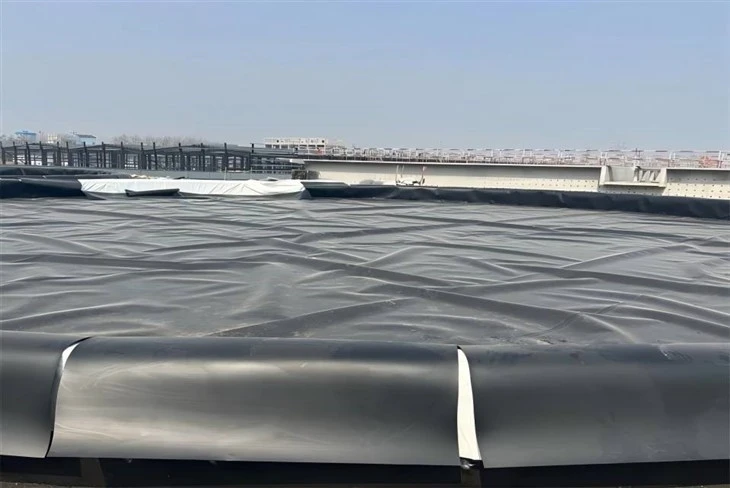
What is Geomembrane LLDPE
LLDPE geomembrane is manufactured from virgin polyethylene resins, offering great flexibility and outstanding resistance to low temperature and ultraviolet exposure. High-quality and economical, it is intended for long life and exhibits a high degree of strength and durability.
Landfill protection
The greatest volume usage of geomembranes is for landfill liners and caps. The sheets prevent landfill debris and leachate from infiltrating groundwater below or escape into the surrounding environment. Leachate collection systems integrate with geomembrane liners to enable safe treatment. Liners also reduce landfill gas emissions.
Remediation applications
At brownfield sites and contaminated properties, geomembranes isolate pollution like heavy metals, volatile organic compounds, or petroleum hydrocarbons until remediation is complete. This technique reduces migration into clean soils or groundwater. Covering contamination is cheaper than full removal in some cases.
Saltwater intrusion barrier
In coastal zones, subsurface geomembrane sheets function as saltwater intrusion barriers to block saline water from entering freshwater aquifers, with biogas digester. The impermeable lines allow freshwater abstraction while preventing saline intrusion inland. This unique use protects limited drinking water resources.
Durability
Unlike compacted clay and other natural liners, geomembranes are highly resistant to chemicals, acids, oils and temperature swings. Proper installation results in a continuous non-permeable layer with a long service life. Regular inspections help identify and repair any damage that could occur over decades of use.

Why Choose Us
High quality
Our products are manufactured or executed to a very high standard, using the finest materials and manufacturing processes.
Professional team
Our professional team collaborates and communicates effectively with each other, and is dedicated to delivering high quality results. We are capable of handling complex challenges and projects that require our specialized expertise and experience.
Advanced equipment
A machine, tool or instrument designed with advanced technology and functionality to perform highly specific tasks with greater precision, efficiency and reliability.
24H online service
We try and respond to all concerns within 24 hours and our teams are always at your disposal in case of any emergencies.
Application of Geomembrane LLDPE
Landfills and Leachate Ponds
Landfills utilize HDPE geomembranes as liners to prevent leachate, which is a toxic liquid formed by rainwater percolating through waste, from contaminating the surrounding soil and groundwater. Leachate ponds, lined with HDPE geomembranes, collect and contain the leachate for proper treatment and disposal, ensuring environmental protection.
Mining and Tailings Management
In the mining industry, HDPE geomembranes as well as XR-5 Geomembranes serve as liners for tailings dams and containment ponds, preventing the release of hazardous chemicals and pollutants into the environment. These liners ensure the safe containment and management of mining by-products, reducing the risk of soil and water contamination.
Agricultural Water Storage
HDPE geomembranes are used in agricultural water storage systems, such as reservoirs, ponds, and irrigation canals, to prevent water seepage and optimize water management practices. These liners help conserve water resources, improve irrigation efficiency, and support sustainable agricultural practices.
Aquaculture and Fish Farming
In aquaculture facilities and fish farms, HDPE geomembranes are employed in pond liners to create a waterproof barrier, preventing water loss and seepage. These liners ensure optimal water retention, maintain water quality, and support the growth and health of aquatic organisms.
Exercise caution during construction and usage to prevent damage to the large lldpe liner from sharp objects and tools. Maintain a clean construction site to minimize mechanical damage.
Prohibit smoking at the construction site and ensure the availability of firefighting facilities if necessary. Shoes with nails or high-heeled hard-soled shoes are not allowed on the membrane surface.
During construction, give special attention to ensuring that the laying is not overly tight, free from wrinkles, and the splicing is secure.
Regularly inspect the lldpe geomembrane surface for any damage or punctures during use. Promptly repair any issues to maintain the anti-seepage effectiveness.
Be mindful of the thermal expansion and contraction effects of the anti-seepage membrane material. Take appropriate measures to prevent soil, granular matter, or foreign objects from entering the geotextile layer after installation.
Commence each day's welding with a 0.9mm×0.3mm on-site trial sample, featuring an overlap width of no less than 10cm. Conduct on-site peeling and shearing tests using a tensile machine.
Ensure that welds are neat and aesthetically pleasing, without any slip welding or skipping.
When joints are affected by condensation, moisture, sediment, etc., perform welding only after appropriate treatment.

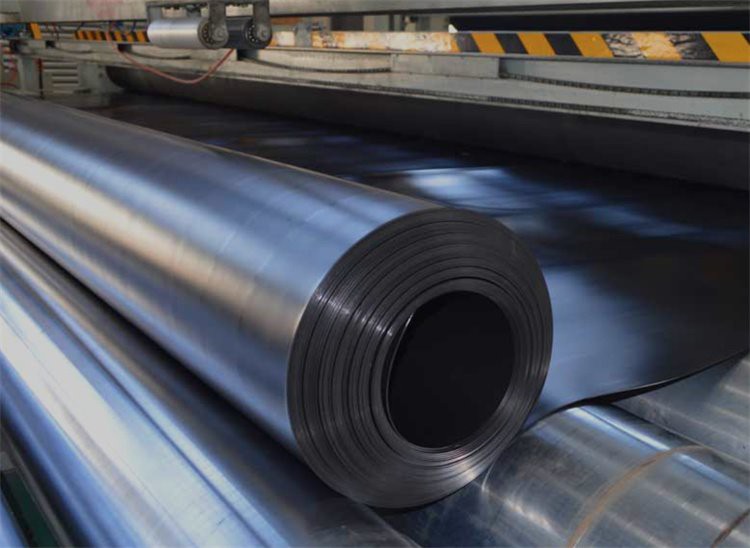
The manufacturing process of a geomembrane is a very important procedure that needs to be done correctly in order to create a high-quality product. There are many steps involved in the manufacturing process, and each step is crucial to the overall success of the final product. First, the polymer resin is selected based on its chemical properties and compatibility with other materials. Then additives such as UV stabilizers and antioxidants are added to enhance its performance when exposed to sunlight or other environmental conditions. The mixture is then pressure-fed into a die that forms it into thin sheets which can be cut into different sizes depending on their intended application. Finally, quality control tests are performed to ensure that the geomembrane meets applicable standards before they are shipped out for installation.
Geomembrane LLDPE Technical specifications
|
Item |
norm |
|||||||
|
Thickness mm |
0.50 |
0.75 |
1.00 |
1.25 |
1.50 |
2.00 |
2.50 |
3.00 |
|
Density g/cm |
≤0.939 |
|||||||
|
Tensile breaking strength (longitudinal, transverse) N/mm |
≥13 |
≥20 |
≥27 |
≥33 |
240 |
≥53 |
≥66 |
≥80 |
|
Elongation at break(longitudinal, transverse)% |
=800 |
|||||||
|
2% positive mold brightness N/mm |
≤210 |
∈370 |
≤420 |
≤520 |
≤630 |
≤840 |
≤1050 |
≤1260 |
|
Right-angle tearing load (longitudinal, transverse) N |
≥50 |
≥70 |
=100 |
≥120 |
≥150 |
≥200 |
≥250 |
≥300 |
|
Puncture strength N |
≥120 |
≥190 |
≥250 |
≥310 |
=370 |
≥500 |
=620 |
≥750 |
|
Carbon black content |
2.0-3.0 |
|||||||
|
Carbon black dispersion |
No more than 1 out of 10 data level 3, level 4, level 5 not allowed |
|||||||
|
Oxidation induction time(OIT)min |
Atmospheric pressure oxidation induction time = 100 |
High pressure oxidation induction time = 400 |
||||||
|
Thermal aging at 85℃(Osh retention at atmospheric pressure after 90d)% |
=35 |
|||||||
|
UV resistance(OT retention after UV irradiation 1600h)% |
=35 |
|||||||
Geomembrane LLDPE Liner Installation Procedures
Pre-Installation Preparation
Clean the construction area thoroughly, removing sharp objects and debris to maintain a smooth foundation.
Check the land's drainage system to ensure efficient drainage beneath the lldpe low density polyethylene linear.
Base Layer Application
After cleaning, apply a layer of fine sand or fine gravel as a base layer, ensuring a secure fit for the lldpe liner sheet.
LLDPE Geomembrane Installation
Lay the LLDPE liner in the targeted area, taking care to avoid wrinkles. Ensure adequate overlap between the edges of the membrane, typically requiring 1-2 feet. Employ hot melt welding at connections to seal the seams.
Secure Fixation
Fix the lldpe geomembrane on the ground surface in the appropriate position to prevent any shifting.
What Is Difference of LDPE Geomembrane Vs LLDPE
Flexibility and stiffness: LDPE (Low-Density Polyethylene) and LLDPE (Linear Low-Density Polyethylene) geomembranes have different levels of flexibility and stiffness due to variations in their molecular structure.
Flexibility: LDPE geomembranes are known for their excellent flexibility. They have a highly branched and amorphous molecular structure, which allows them to exhibit superior flexibility and elongation properties. LDPE geomembranes can conform to irregular surfaces and accommodate ground movements, making them suitable for applications where flexibility is crucial.
Stiffness: LDPE geomembranes tend to be less stiff or rigid due to their highly branched molecular structure. This flexibility allows LDPE geomembranes to withstand deformation and elongation without rupturing or tearing. However, the lower stiffness of LDPE geomembranes can sometimes make them less suitable for applications that require higher structural integrity or resistance to mechanical stresses.
Chemical Resistance and Compatibility: Both LDPE (Low-Density Polyethylene) and LLDPE (Linear Low-Density Polyethylene) geomembranes offer good chemical resistance, but there are some differences in their chemical compatibility due to variations in their molecular structures. Here's a comparison of their chemical resistance and compatibility.
Methods to Repair the Leak of Geomembrane LLDPE
When the damaged part is small: This is the simplest and easiest damage to repair. Generally, the diameter of the damage is not more than 6mm. To repair such damage, you only need to clean up the damaged geomembrane and the surrounding area, and then use a squeeze torch to repair it.
When the damaged part is on the plane of the geomembrane: This is the most common and common type of damage. To repair such damage, you need to clean up the damaged part, measure the area of the damaged part, and then cut the repair material of the same material and thickness into a round or oval shape (the area is About three times the damaged part) cover the damaged part for repair. Generally, hot air gun, squeeze welding torch or special geomembrane glue is used to repair such damage.
When the damaged part is at the joint of the geomembrane: The occurrence of such damage is generally due to the cracking of the welded seam caused by the stress of the geomembrane. To repair such damage, the cracked welded seam must be cleaned up, and then re-welded with a double-track crawling welding machine. Use an extrusion welding gun for welding repair. After the repair is completed, the repaired part should be pressure tested to prevent cracking again.
When the damaged part is at the edge of the geomembrane or when the damaged part is larger or more: Generally, there is no need to repair such damage. You can cut the damaged geomembrane directly and re-lay the intact geomembrane for welding. load pressure range.
When the damaged part is at the corner or combined with other materials:It is very difficult to repair such damage, and the repair method should be carefully selected according to the actual situation. Generally, joints or places with small damage should be repaired with an extrusion welding torch, areas with small damage at the corners should be repaired with hot air guns, and areas with large damage at the corners should be patched with welding machines.
FAQ
Q: What is the difference between LDPE and LLDPE?
Q: What is LLDPE plastic used for?
Q: What is geomembrane material?
Q: Why is LLDPE better than LDPE?
Q: Why is LLDPE tougher than LDPE?
Q: What is the purpose of a geomembrane?
Q: Is LLDPE better than HDPE?
Q: Which is stronger LDPE or LLDPE?
Q: What category of plastic is LLDPE?
Q: Is HDPE a geomembrane?
Q: How is geomembrane manufactured?
Q: What is the difference between GCL and geomembrane?
Q: Is LLDPE plastic safe to use?
Q: Is LLDPE plastic food grade?
Q: Can LLDPE be recycled?
Q: Can you mix LLDPE and HDPE?
Q: Can LDPE and Lldpe be recycled together?
Q: How thick is a geomembrane?
Q: What is the service life of geomembrane?
Q: What is the difference between LLDPE and HDPE liners?
Hot Tags: geomembrane lldpe, China geomembrane lldpe suppliers, factory, PO Agricultural Film, EVA Agricultural Film Series Products, Silver Black Plastic Film, Light Conversion Film Series, Special Film for Animal Husbandry, Degradable Mulch